Corporate lawyers email list
In-house counsel is a subclass of corporate lawyer, so company-side records pair with the private-practice attorneys who advise the same businesses.
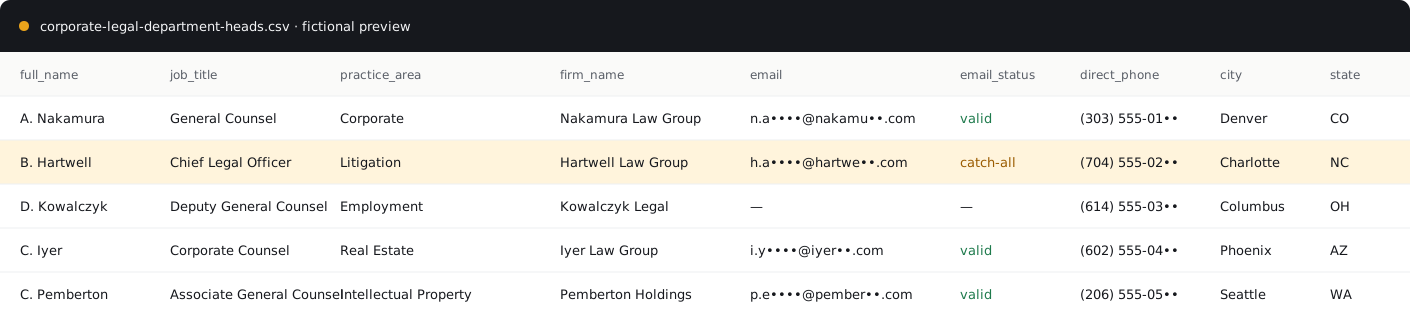
The general counsel email list reaches the lawyers who run legal departments inside US companies: general counsel, chief legal officers, and in-house or corporate counsel. Order records by role, state, city and ZIP code, each row carrying the job title, employer name, office mailing address and direct phone. Verified email covers 65% of the 1,000,000 records in the database, tested with ZeroBounce and NeverBounce. A free sample and a written quote come first.
Who is included
An in-house counsel email list holds lawyers employed by a company rather than by a law firm: general counsel, chief legal officers, and in-house or corporate counsel. Each record names the title, the employer, the practice area recorded for that lawyer, and the office where the legal department sits.
In-house counsel serve 1 client. Rule 1.13(a) of the District of Columbia Rules of Professional Conduct states that a lawyer employed or retained by an organization represents the organization acting through its duly authorized constituents, so the company is the client and its officers are not. That single-client relationship is what separates these rows from private-practice rows.
Job titles carry the distinction into the data. O*NET, the occupational database sponsored by the US Department of Labor, lists General Counsel and Counsel among the reported job titles for occupation code 23-1011, Lawyers. The role field in this database uses 16 values, and 3 of them describe company-side work: general counsel, chief legal officer, and in-house or corporate counsel.
Buyers name the same file in several ways. A corporate counsel email list, a legal counsel email list and a general counsel contact list all resolve to those 3 role values, and what an in-house counsel email list covers is settled by the role filter rather than by the employer's industry.
Two neighboring segments sit outside this selection. Law firm leadership belongs with managing partner contacts at law firms, because partners sell legal services instead of buying them, and government lawyers belong in the prosecutor and public defender email list.
Field coverage
Firm name, full mailing address, direct phone, practice area and Google Business Profile sit on 100% of records. Google rating and reviews reach 97%, websites 86%, verified email 65%, Facebook 52% and Instagram 33%. Bar number, bar admission state, job title, LinkedIn profile and firm size ship without a published fill rate.
| Field | Coverage bar | Share of records |
|---|---|---|
| Firm name | 100% | |
| Full mailing address | 100% | |
| Direct phone number | 100% | |
| Practice area | 100% | |
| Google Business Profile | 100% | |
| Google rating and reviews | 97% | |
| Website | 86% | |
| Verified email | 65% | |
| Facebook page | 52% | |
| Instagram handle | 33% |
Also in every file: bar number, bar admission state, job title, LinkedIn profile, firm size and an email status column that flags catch-all addresses.
On an in-house record the firm name column holds the employer's company name, and the address is that company's office rather than a law firm. Every percentage below describes all 1,000,000 records instead of this segment, so the free sample is what shows how email and LinkedIn fill for the legal departments you pick.
Chief legal officers
A chief legal officer is the senior lawyer inside a company, the title federal securities rules treat as the counterpart of general counsel. The chief legal officers email list selects that role value alone or beside general counsel, so outreach lands with the person who approves legal spending.
Federal rules give the title a defined task. Under 17 CFR 205.3(b)(1), an attorney appearing and practicing before the Securities and Exchange Commission who becomes aware of evidence of a material violation reports it to the issuer's chief legal officer, or to the chief legal officer and the chief executive officer together. Paragraph (b)(2) then places the resulting inquiry in the chief legal officer's hands.
Escalation runs upward from that desk. Absent an appropriate response within a reasonable time, 17 CFR 205.3(b)(3) sends the report to the audit committee of the board, to another committee made up of independent directors, or to the board itself. The Commission adopted this part on February 6, 2003 under section 307 of the Sarbanes-Oxley Act.
Company usage decides which of the 2 titles appears on a record. A chief legal officers contact list therefore ships beside general counsel and chief legal officer contacts at the same employers, and both titles narrow by state, city, ZIP code and the firm size field.
Why vendors sell here
Electronic billing platforms, matter management software, outside counsel and research tools are the recurring purchases of a corporate legal department. The general counsel or the legal operations team signs for each of them, which is why in-house lawyer contacts are the target for legal technology and professional services vendors.
The billing standards behind those purchases are public. The Uniform Task Based Management System, UTBMS, is a series of codes that classify legal services on an electronic invoice, and the LEDES Oversight Committee, which maintains it, records that a joint group from the American Bar Association, the Association of Corporate Counsel and PricewaterhouseCoopers built the system in the mid-1990s for US law departments and insurers.
Coding has widened since. The original ABA litigation code set, released in 1997, holds 5 phases and 29 task codes, and UTBMS.com now lists further sets for bankruptcy, counseling, criminal, real estate, workers' compensation, mergers and acquisitions, e-discovery, patent and trademark work. LEDES, the Legal Electronic Data Exchange Standard begun by an informal group in 1995, supplies the invoice file formats those codes travel in.
Bar records
In-house lawyers hold an active license in at least 1 US state, and a second state admits them through an in-house registration instead of its bar exam. California Rule of Court 9.46 registers those lawyers to advise only the qualifying institution that employs them.
California states the conditions plainly. Rule 9.46 defines a qualifying institution as a corporation, partnership, association or other legal entity with an office in California, rules out government entities and entities that provide legal services to others, and asks the employer to have at least 5 full-time employees or to employ an active California licensee. Subdivision (c) requires the registered lawyer to reside in California and to practice for a single qualifying institution.
The registration is deliberately narrow. Registered in-house counsel provide legal services in California only to the employer, take no court appearance that would otherwise require pro hac vice admission, and give no personal representation to officers, shareholders or employees, apart from supervised pro bono work. The current text of subdivision (b) took effect on October 1, 2025.
Records carry the licensing facts rather than the registration type. Each row holds a bar number and a bar admission state next to the job title, so any campaign that turns on a single jurisdiction is checked against those 2 fields before the send.
Selection and delivery
Selection runs on role, state, city, ZIP code and the firm size field, and an order starts at 1,000 records. Our team emails a free sample and a quote within 1 hour, Monday to Friday, 9am–6pm UTC, and the finished file arrives as CSV or Excel.
A quote rests on 4 inputs: the record count, the fields you keep, the practice area and the state. Payment is a one-time charge by PayPal, bank transfer, invoice or cryptocurrency, and no subscription attaches to it.
Delivery follows cleared payment by email within 2 hours. The 12-month license covers your own outreach and excludes resale, and every sale is final once a file leaves us, which is why the sample settles coverage questions first.
Currency is kept on a monthly cycle. This database is refreshed and deduplicated each month, our team checks attorney details against state bar websites, and September 10, 2026 is the date of the last full verification.
Related lists and guides
Name the titles, the states and the record count you need. Our team returns a free sample and a quote within 1 hour during business hours.
Questions
Yes, as separate role values. Paralegal, legal assistant and office manager are 3 of the 16 roles, and each ships as its own selection instead of sitting inside the in-house lawyer count.
Yes. Chief legal officer is its own role value and stands alone in a file. Add general counsel or in-house counsel when one title falls short of the 1,000-record minimum.
No. Each row carries a practice area, not an employer industry code. Narrow by role, state, city and ZIP code, then read the employer names in the free sample.
Work addresses. Verified email covers 65% of the database, every address runs through ZeroBounce and NeverBounce, and an email status column flags catch-all domains before a campaign starts.
No. Coverage is US companies across all 50 states and their cities. Files of in-house counsel in the United Kingdom, Canada and Australia are planned for a later release.